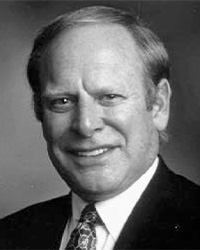
Othmar Hermann Ammann (1879-1965)
Believed to be the greatest bridge builder of the 20th century, Ammann’s innovative genius was his ability to anticipate future challenges. Born in Switzerland, he came to New York in 1904, where his gift for long span bridge design and forward thinking matched perfectly with the city’s need to connect its five growing boroughs and the island of Manhattan to the mainland U.S.
Ammann was commissioned in the design and construction of over 16 major bridge projects, founded two public port agencies, and launched two private engineering firms.
His designs were the result of constant innovation, culminating in record-breaking and aesthetically beautiful structures, including the iconic George Washington Bridge (GWB). Seeing the great potential of “motor-cars,” Ammann designed the GWB with future needs in mind. Originally constructed with six lanes and two sidewalks, Ammann left a 32-foot-wide unpaved strip in the center of the GWB and provided enough capacity to accommodate a second, lower roadway, which were both utilized, in 1946 and 1958, respectively. At the time of its completion, it was the longest bridge span in the world.
From the monolithic plate steel on the Bronx-Whitestone towers, to the innovative truss system of the Verrazano-Narrows Bridge, which considered the curvature of the earth and was the longest suspension bridge in the world for almost 20 years, Ammann pushed the limits of possibility to deliver functional and forward-thinking structures.